
Joint pain, posture problems, osteoarthritis in the knee, or an irregular arch of the foot are often at the root of more problems than you may have expected.
But how does one end up with either a flat foot or a cavus foot? How do these differ from a normal foot? Let’s explore the different types of feet and their impact on daily life.
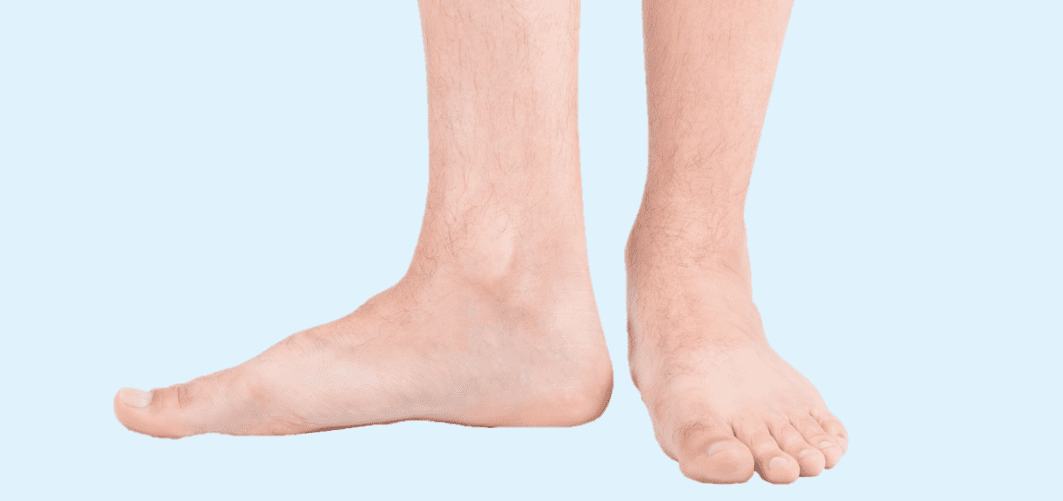
Flat foot
The flat foot is characterized by a sagging arch. This condition can cause various problems if untreated.
To check for flat feet, place your wet foot on a dark cardboard sheet; an imprint showing the entire foot indicates flat feet.
People with flat feet may experience:
- Foot pain due to the absence of an arch;
- Instability when standing on one foot;
- A smaller Achilles tendon than usual;
- Discomfort affecting ankle, knee, and hip joints;
- Knee valgus;
- Inward curving ankles;
- Arch pain;
- Lower back pain and tension.
If untreated, flat feet can lead to complications such as:
- Achilles tendonitis;
- Bunion (hallux valgus);
- Metatarsalgia;
- Postural difficulties;
- Morton’s neuroma;
- Heel spur;
- Plantar fasciitis.
Early podiatric treatment can provide options to minimize the discomfort caused by flat feet. Common treatments include:
- Custom-made foot orthoses;
- Composite insoles;
- Fitted shoes;
- Corrective bone or ligament surgery.
Cavus foot
A cavus foot presents an exaggerated arch with too much curvature.
Using the same wet foot imprint test, a cavus foot leaves a thin mark showing only the tip of the foot and heel.
In contrast to flat feet, cavus feet may be linked to neurological conditions.
Characteristics of cavus feet include:
- Very stiff foot;
- A visible bump on top of the foot;
- Frequent calf cramps;
- Balance difficulties;
- Recurring ankle sprains;
- Joint pain in feet, ankles, hips, and knees;
- Difficulty fitting shoes correctly.
If you notice these symptoms, consider consulting a podiatrist.
Podiatrists use postural evaluation and 2D / 3D scanning to understand the foot’s impact on the body.
Cavus feet can also cause:
- Heel bursitis;
- Metatarsalgia;
- Plantar fasciitis;
- Excessive underfoot calluses;
- Postural imbalance;
- Hammertoes;
- Painful bunion (hallux valgus).
Podiatrists offer therapeutic treatments such as:
- Manual foot therapy to mobilize joints and soften the foot;
- Custom foot orthoses to improve posture and lifestyle.
PiedReseau: because not everyone has a regular foot arch
Whether you have flat or cavus feet, it is crucial not to neglect your pain.
PiedReseau podiatrists specialize in diagnosing foot deformities and providing tailored treatments.
Contact your PiedReseau clinic before damage becomes irreversible.