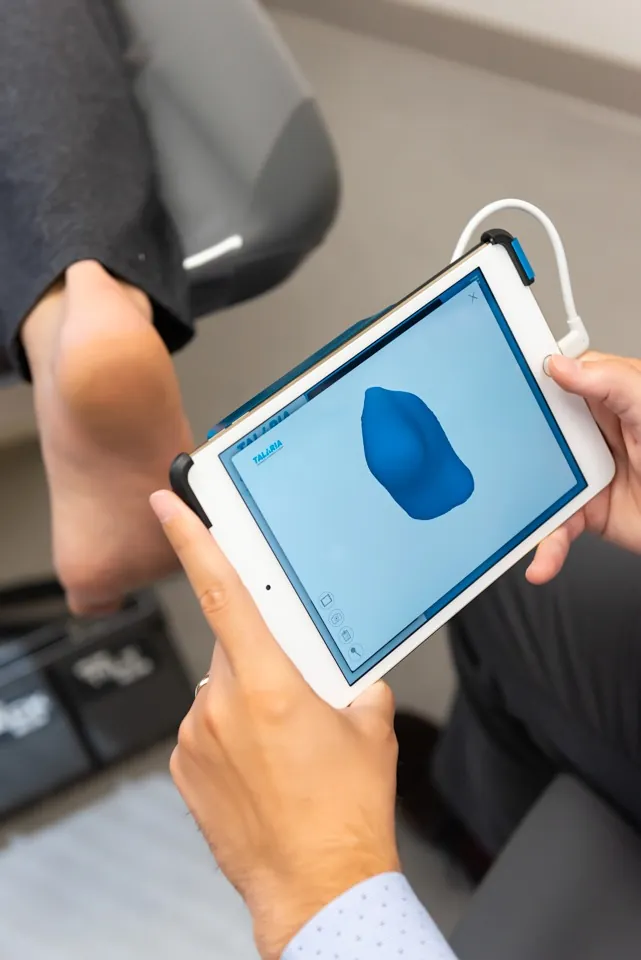

Foot imprint digitization captures the foot’s plantar surface using devices that enable precise diagnosis, essential for designing custom-made plantar orthotics. Two main technologies exist: 2D impressions taken by a podograph, which maps pressure points on a pressure-sensitive cushion or scan, and 3D scanning that uses three-dimensional sensors to reproduce the full morphology of the foot. These scanning methods expedite the diagnosis of foot discomfort.
Why take a foot imprint?
For podiatrists, foot imprinting is both a diagnostic tool and a method for creating advanced foot orthotics, playing a key role in understanding postural imbalances. The 2D foot scanning offers detailed pressure point mapping and identifies characteristics such as foot size, arch type (flat, hollow, medium), foot position when flat, and weight distribution. Although faster than plaster casting, 2D scanning is less versatile than 3D technology.
3D foot exploration can involve:
- Laser triangulation: Digitally models the foot using distance calculations between a light source and the foot’s contour.
- Structured light scanning: Similar technique using infrared light.
3D scanners save time in diagnosing plantar disorders and help design high-performance orthotics to treat conditions like flat foot, Morton’s neuroma, hammer toe, plantar fasciitis, metatarsalgia, and hallux valgus.
What is the process of digital imaging of the foot?
Unlike digital radiography, digital foot scanning does not use X-rays but focuses on the foot’s mechanical and structural features. The process improves diagnosis and the precision of orthotics manufacturing.
Digitization techniques include:
- Load technique: Patient is upright while impressions are digitized.
- Semi-load technique: Patient seated, impressions taken under applied load.
- No-load technique: Feet positioned above a scanning platform without weight.
2D scanning requires alternating load and no-load positions to capture varying foot behaviour. 3D scanning involves painless steps: foot positioning, initial scanning, possible repositioning, scanning the other foot if necessary, creation of a 3D virtual foot model, and result analysis by the podiatrist for treatment planning.
Sometimes, a more comprehensive evaluation of posture and lower limbs is needed, requiring postural evaluation.
Advantages of plantar digitization
Plantar digitization via 2D and 3D scans differs markedly from the traditional plaster casting, though the latter remains in use. Clinics increasingly prefer digital methods for their multiple benefits:
- Faster and more detailed foot analyses.
- Highly accurate assessment of foot surface and volume.
- Effective detection of morphological changes, important for conditions like osteoarthritis.
- Production of customized orthotics to correct issues such as pronation or prevent diabetic foot ulcers.
- A gentler, quicker scanning experience without plaster casting discomfort.
Digital foot imprint techniques are painless and yield detailed results, while podiatrists combine their expertise with advanced tools to provide fast, effective treatment. Book your appointment today to benefit from digital foot imaging.